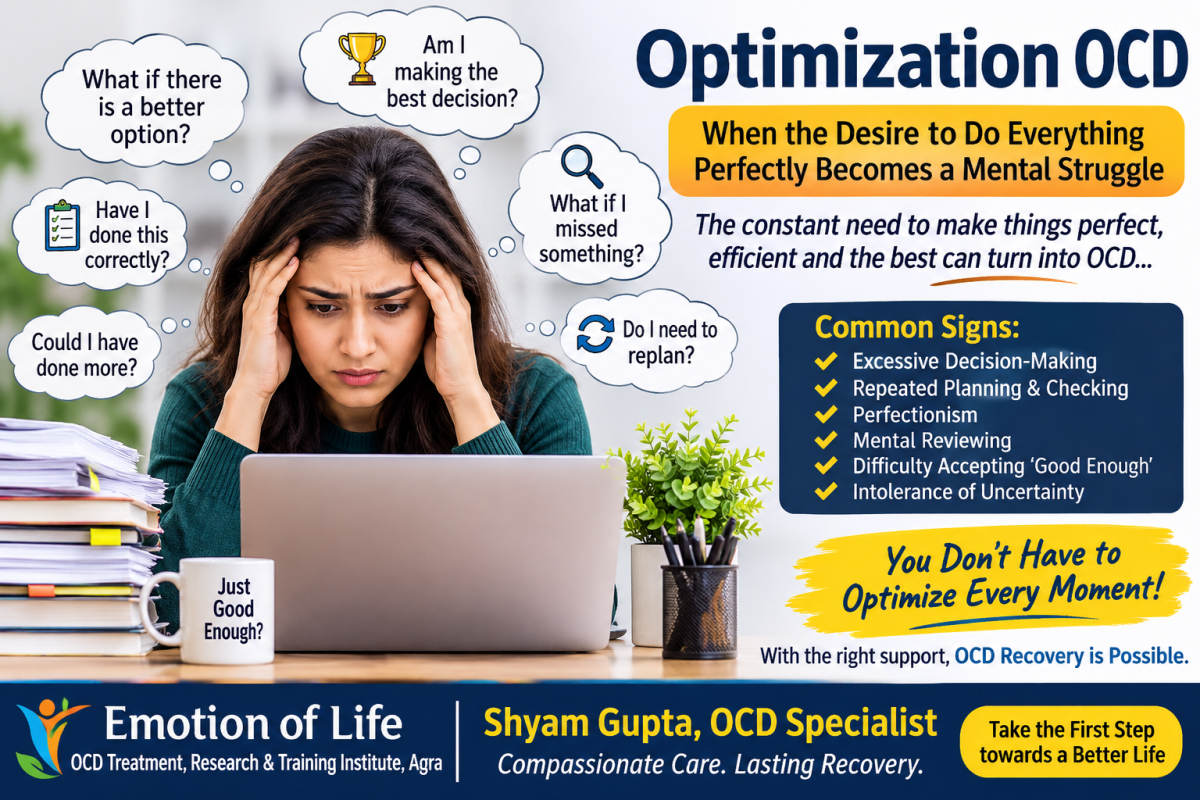
Optimization OCD people affected with Optimization OCD are constantly encouraged to improve themselves, become more productive, make better decisions, and achieve higher standards. While self-improvement is a positive quality, for some individuals, the desire to optimize every aspect of life can become overwhelming. When the pursuit of perfection, certainty, or the best possible outcome becomes repetitive, distressing, and difficult to control, it may be associated with Optimization OCD.
Optimization OCD is a term sometimes used to describe obsessive-compulsive symptoms centered around the need to make things perfect, efficient, correct, or maximally optimized.
What Is Optimization OCD: Optimization OCD refers to a pattern in which an individual experiences persistent doubts and obsessive thoughts about whether something could be done better, more correctly, or more efficiently. The person may feel compelled to repeatedly review, compare, calculate, organize, or modify something until it feels completely right. For example, an individual may spend hours trying to select the perfect laptop, create the ideal daily routine, organize files in the most efficient way, or make a decision that guarantees the best possible result. The difficulty is not simply that the person wants to do things well. The difficulty arises when the mind demands an unrealistic level of certainty or perfection and refuses to allow the person to move forward.
The individual may repeatedly think:
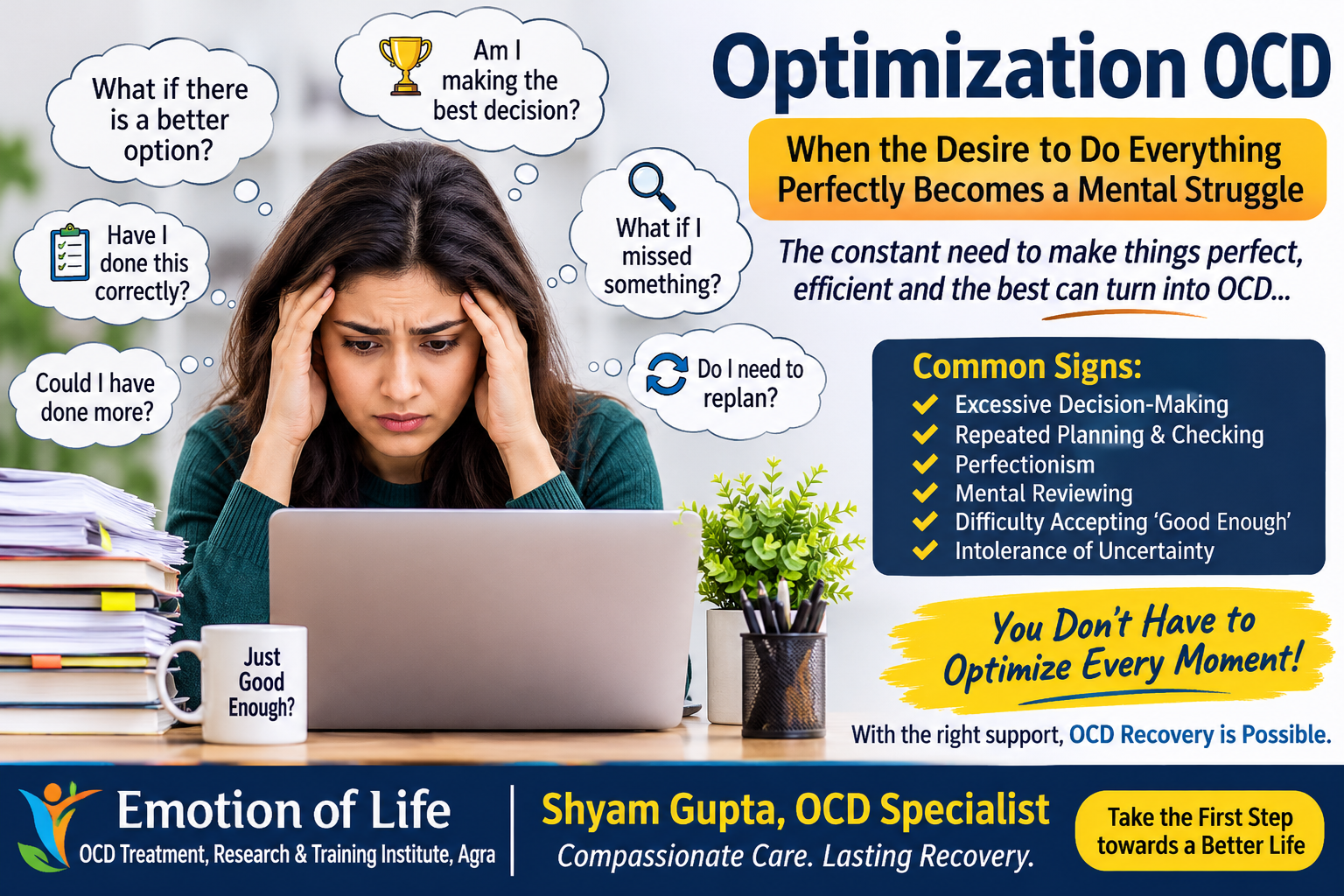
- “What if there is a better option?”
- “What if I have made the wrong decision?”
- “Could I have done this more efficiently?”
- “What if I missed something important?”
- “I cannot stop until everything feels right.”
Over time, these thoughts can interfere with daily functioning, relationships, professional responsibilities, and emotional well-being.
Symptoms of Optimization OCD: Optimization OCD may involve a combination of obsessive thoughts, repetitive mental activities, and behavioral compulsions.
- Excessive Decision-Making: A person may struggle to make even ordinary decisions because they want to identify the absolute best option. They may compare products, services, schedules, or choices repeatedly, even after sufficient information has been gathered.
- Repeated Planning and Re-planning: The individual may create a daily routine, productivity system, or personal development plan and then repeatedly modify it. Even after completing a satisfactory plan, the person may feel that it is not ideal enough to follow.
- Perfectionistic Checking: The person may repeatedly check whether a task has been completed correctly, whether an answer is accurate, or whether an opportunity for improvement has been missed.
- Mental Reviewing: Some individuals experience repetitive mental calculations, comparisons, or internal discussions. They may mentally review past decisions, evaluate alternative possibilities, or attempt to prove to themselves that they selected the best option.
- Difficulty Accepting “Good Enough”: A satisfactory result may not provide lasting relief. The person may continue searching for improvements even when the existing outcome is already appropriate and functional.
- Excessive Research: Research may become repetitive and compulsive. The individual may read multiple reviews, watch numerous comparison videos, consult several people, and continue searching even after the decision has been made.
- Intolerance of Uncertainty: The person may find it extremely difficult to accept that every decision involves some uncertainty. They may believe that making the wrong choice will result in serious regret, failure, or an irreversible mistake.
Examples of Optimization OCD in Everyday Life
Optimization-related OCD symptoms can appear in many areas of life.
At work: A professional may repeatedly revise a presentation, report, or email because it does not feel perfectly structured.
In education: A student may spend excessive time selecting the best study method instead of actually studying.
In personal finance: Someone may repeatedly compare investment options or financial decisions, seeking complete certainty that they have chosen the best one.
In health and fitness: A person may obsessively adjust exercise schedules, diet plans, or wellness routines to achieve the ideal result.
In relationships: An individual may repeatedly analyze conversations, compare relationship experiences, or question whether they are making the perfect relationship decision.
In technology: Someone may spend hours optimizing computer settings, software configurations, or digital workflows, even when the system is already working well.
These examples do not automatically indicate OCD. The clinical significance depends on the presence of obsessive-compulsive patterns, distress, time consumption, and interference with everyday life.
Why Does Optimization OCD Develop: OCD is a complex condition involving psychological, cultural, early age home environmental factors specially parenting issues, individual developed skeued personality dynamics. Lower side of emotional health, persona believes etc. Some other psychological processes may contribute to optimization-related obsessions and compulsions.
Perfectionism: The person may believe that anything less than the best possible outcome is unacceptable.
Intolerance of Uncertainty: The individual may experience uncertainty as threatening and attempt to eliminate it through repeated analysis.
Inflated Responsibility: The person may feel responsible for preventing every possible mistake or negative outcome.
Fear of Regret: The individual may believe that choosing an imperfect option will lead to unbearable regret.
The Need for a “Just Right” Feeling: Some people experience a strong internal discomfort when something does not feel complete, correct, balanced, or satisfactory. They may continue repeating an activity until the uncomfortable feeling temporarily decreases. These factors can interact with the OCD cycle, reinforcing the need to repeat behaviors or mental activities.
The OCD Cycle in Optimization OCD
Optimization OCD often follows a recognizable pattern:
Trigger → Obsession → Anxiety or Discomfort → Compulsion → Temporary Relief → Repetition
For example:
A person selects a new laptop.
They begin thinking, “What if another model is better?”
This creates anxiety, doubt, and fear of regret.
The person starts comparing specifications, reading reviews, and checking prices repeatedly.
After several hours, they may feel temporarily reassured.
However, the relief does not last. A new doubt appears, and the cycle begins again.
The person gradually learns to depend on repeated checking and analysis to manage uncertainty.
Unfortunately, compulsions may strengthen the OCD cycle rather than resolve the underlying difficulty.
Treatment of Optimization OCD: Optimization-related OCD symptoms can be addressed through evidence-based OCD treatment. The treatment approach should be individualized according to the person’s symptoms, severity, functional difficulties, and clinical needs.
- Cognitive Behavioural Therapy (CBT)
CBT helps individuals understand the relationship between obsessive thoughts, emotional distress, and compulsive responses. Treatment may focus on identifying beliefs such as:
- “I must always make the best decision.”
- “A mistake means I have failed.”
- “I cannot tolerate uncertainty.”
- “I must continue until everything feels perfect.”
The goal is not to eliminate every desire for improvement but to develop a more flexible and balanced relationship with thoughts and decisions.
- Exposure and Response Prevention (ERP)
Exposure and Response Prevention (ERP) is a well-established psychological treatment for OCD. In ERP, the individual gradually faces situations that trigger obsessive doubts while learning to resist compulsive responses. For optimization-related symptoms, ERP may involve:
- Making a decision without researching every available option.
- Completing a task without repeatedly editing it.
- Following a routine without constantly redesigning it.
- Accepting a satisfactory result without further checking.
- Allowing uncertainty about whether a better option exists.
The purpose is not to force perfection or guarantee that anxiety will disappear immediately. Instead, the person learns that uncertainty and discomfort can be tolerated without performing compulsions.
- Reducing Mental Compulsions
Optimization OCD may involve compulsions that are difficult to recognize because they occur entirely in the mind. Examples include:
- Repeatedly comparing alternatives mentally.
- Replaying decisions.
- Calculating whether the best choice was made.
- Seeking internal reassurance.
- Trying to achieve complete certainty.
Treatment helps individuals recognize these mental rituals and practice responding differently.
- Developing Decision-Making Flexibility
A useful therapeutic goal is to develop practical decision-making boundaries. For example, a person may decide to:
- Set a reasonable time limit for ordinary decisions.
- Gather sufficient information rather than exhaustive information.
- Choose an acceptable option without searching indefinitely.
- Avoid reopening completed decisions simply because doubt appears.
These strategies should be used as flexible therapeutic guidelines, not as new rigid rules that the person feels compelled to follow perfectly.
- Learning to Accept Imperfection
Recovery involves learning that life does not require every decision, task, or experience to be optimized. A person can make a reasonable decision without knowing whether it is the absolute best decision. They can complete a task without feeling completely satisfied. They can move forward without resolving every doubt. This flexibility is an important part of overcoming the compulsive need for perfection and certainty.
Can Optimization OCD Be Treated Without Medication?
Depending on the individual’s clinical needs optimization ocd can be easily treated without medicine with structure CBT with ERP based ocd recovery program. At Emotion of Life, our specialized OCD Recovery Program focuses on individualized psychological care, CBT, ERP, theme based counseling, and structured post recovery follow up clients are able to reach to ocd cure state as well.
Emotion of Life approach emphasizes helping individuals understand their OCD patterns, reduce compulsive behaviors, and develop the ability to live with greater flexibility and confidence. Treatment outcomes vary from person to person and treatment outcome depend on client commitment, trust and following process of ocd recovery.
When is the right time to approach Professional service:
- You spend excessive time trying to make perfect decisions.
- You repeatedly research or compare options despite having enough information.
- You cannot complete tasks because they do not feel sufficiently optimized.
- You experience distress when something is not done in the ideal way.
- Your daily routine, work, studies, or relationships are affected.
- You feel unable to stop repetitive checking, reviewing, or mental analysis.
A professional assessment can help determine whether these experiences are related to OCD, perfectionism, anxiety, or another psychological concern.
OCD Recovery Success Story of Arvind:
Inspiring story of a young woman who had been struggling with severe contamination-related Obsessive-Compulsive Disorder (OCD). Her OCD thoughts and compulsive behaviours were consuming several hours of her day, significantly affecting her professional responsibilities, productivity, and quality of life. Despite consulting several psychologists and psychiatrists, she had not experienced the meaningful improvement she was hoping for. The advice she received from previous professionals seemed similar, and her symptoms continued to interfere with everyday living. Her family was deeply concerned and continued searching for a specialized OCD treatment approach. That search eventually led them to Emotion of Life – OCD Treatment, Research & Training Institute, Agra.
The Turning Point: Finding an OCD Specialist Who Understood
During a desperate online search, her family discovered Emotion of Life through Google and decided to seek an initial consultation with Shyam Gupta, OCD Specialist Therapist. According to Arvind review, she was surprised by how accurately Shyam Gupta understood the nature of her OCD thoughts, contamination fears, anxiety, and compulsive behaviours during the initial consultation. For the first time, she felt that her difficulties were being understood in a structured and meaningful way. Following the consultation, she was offered a personalized five-month OCD Recovery Program consisting of daily therapeutic sessions, approximately 45–60 minutes each, five days a week. Initially, she decided to commit to the first month and evaluate her progress. That decision became an important step in her recovery journey.
A Structured Recovery Journey: 100 Sessions Over 150 Days
The program focused on helping her understand and respond differently to the OCD patterns that had been controlling her daily life. With consistent therapeutic engagement, she gradually began developing a better understanding of her OCD and anxiety-related difficulties. The structured program provided an opportunity to work on the same situations that had previously triggered significant distress and compulsive responses. As the journey progressed, she continued to experience meaningful changes in her ability to manage OCD. According to Arvind review, she completed almost 100 sessions over approximately 150 days and had achieved an estimated 95% improvement in her symptoms and functioning. This progress was particularly meaningful because her OCD had previously affected several hours of her day and had significantly disrupted her work and productivity.
Life After Significant Improvement: One of the most encouraging aspects of this recovery journey was not simply the reduction in symptoms, but the change in how she was able to respond to situations that had previously felt overwhelming. According to the review, she was now able to navigate the same problems with much greater ease and understanding. Situations that had once dominated her day were becoming more manageable. Her increased understanding of OCD and her improved ability to handle contamination-related difficulties gave her renewed confidence and hope. At the time of the review, she was continuing the fifth month of her program, with the goal of making further progress and maintaining her recovery. Her journey demonstrates the importance of consistent therapeutic work, individualized treatment planning, and developing a deeper understanding of OCD rather than relying only on general advice.
A Message of Hope for Those Struggling With OCD:
Arvind concluded his review with an encouraging message for individuals who may be suffering silently: He recommended that people struggling with OCD consider giving Emotion of Life a chance, describing it as potentially one of the best decisions they could make. His review reflects the hope that families experience when they begin to see meaningful improvement in a loved one’s life after a prolonged struggle. At Emotion of Life, we believe that every individual experiencing OCD deserves to be understood with compassion, treated with clinical seriousness, and supported through a structured recovery journey. This story is a reminder that even when OCD has become severe, chronic, and deeply disruptive, meaningful improvement can still be possible.
OCD Recovery is Possible: A Note From Emotion of Life, We sincerely appreciate Arvind for sharing this encouraging review and expressing his confidence in our OCD Recovery Program. Every recovery journey is unique. The progress described in this story reflects one individual’s reported experience and should not be interpreted as a guaranteed treatment outcome for everyone. Our commitment remains to provide individualized, evidence-informed psychological care and structured therapeutic support to individuals struggling with OCD. At Emotion of Life, we continue to work toward helping people move beyond the limitations of OCD and reclaim their confidence, productivity, and quality of life.
OCD Recovery Success Story of Priyanka
My whole life I had been dealing with OCD that has given me immense pain and suffering. In my most troublesome time when I had no hope, God sent Shyam Sir in my life. I am not going overboard when I say that I see God in his form in front of me. His passion for what he does cannot be expressed in words. He is doing such great work for people who are suffering so much and is giving the hope of 100% recovery on a topic on which other people usually say that its only manageable not 100 percent curable. His whole life is dedicated to OCD recovery. I have also achieved a lot of relief in my suffering, I am in the process of getting cured, I feel I am 80 percent okay now and will reach the 100 percent stage soon too. To all the people out there who see that there is no hope and have a question of why me?, please try Emotion of life and you will not regret. If I can get cured, you can too. He made me believe that nothing is impossible. And believe me the pain is excruciating and the relief I am getting feels like a breath of fresh air.
FAQ on Optimization OCD:
1. What is Optimization OCD?
Optimization OCD is a descriptive term used for OCD symptoms involving an excessive need to make decisions, activities, or outcomes perfect, efficient, or ideal. Individuals may experience persistent doubts about whether they have chosen the best option or completed a task in the best possible way. They may repeatedly research, compare, check, or mentally review decisions to achieve certainty or a “just right” feeling. Optimization OCD is not a separate official OCD diagnosis but may occur within the broader presentation of Obsessive-Compulsive Disorder.
2. What are the common symptoms of Optimization OCD?
Common symptoms may include excessive decision-making, repeated planning and replanning, compulsive research, perfectionistic checking, mental reviewing, and difficulty accepting satisfactory results. Individuals may repeatedly question whether they could have done something better, even when the task is already complete. These patterns may consume significant time, create anxiety, and interfere with work, studies, relationships, and everyday activities.
3. What is the difference between Optimization OCD and healthy self-improvement?
Healthy self-improvement is flexible, goal-oriented, and allows a person to accept reasonable outcomes. Optimization OCD may involve repetitive doubts, distress, and compulsive attempts to achieve certainty or perfection. A person with optimization-related OCD symptoms may feel unable to stop researching, checking, or improving something until it feels completely right. The key difference is whether the pursuit of improvement becomes compulsive and interferes with daily functioning.
4. How can Optimization OCD be treated?
Optimization OCD symptoms can be treated through evidence-based psychological interventions, particularly Cognitive Behavioural Therapy (CBT) incorporating Exposure and Response Prevention (ERP). Treatment may involve learning to make decisions without excessive research, completing tasks without repeated checking, accepting uncertainty, and reducing mental compulsions. A qualified OCD-specialist mental health professional can assess the symptoms and develop an individualized treatment plan.
5. Can Optimization OCD be treated without medication?
Some individuals with OCD pursue psychological treatment without medication, and CBT with ERP is a well-established psychological treatment for OCD. Treatment decisions depend on symptom severity, clinical needs, and individual circumstances. At Emotion of Life – OCD Treatment, Research & Training Institute, Agra, our specialized OCD Recovery Program incorporates individualized psychological care, CBT, ERP, and structured therapeutic support. A qualified professional can help determine the most appropriate treatment approach for each individual.
Conclusion: A person need to understand that they do not have to Optimize Every Moment of their Life. The desire to improve is a valuable human quality. It helps us learn, grow, and achieve meaningful goals. However, when the mind demands that every decision must be perfect, every task must be optimized, and every uncertainty must be eliminated, self-improvement can turn into a source of suffering. The solution is not to stop caring about quality. The solution is to stop allowing the pursuit of perfection to control your life. You do not need to make the best possible decision every time. You need to make a reasonable decision and allow yourself to move forward. You do not need to eliminate every doubt. You need to learn that doubt can exist without requiring a compulsive response. With appropriate assessment, evidence-based treatment, and consistent therapeutic practice, individuals can learn to reduce compulsive optimization and regain the freedom to live a meaningful, flexible, and fulfilling life.
About Emotion of Life
Emotion of Life – OCD Treatment, Research & Training Institute, Agra, specializes in psychological treatment and recovery support for individuals experiencing Obsessive-Compulsive Disorder. Our OCD Recovery Program incorporates CBT, ERP, individualized therapeutic planning, and structured recovery support.
Emotion of Life believes in 100 Days 100 Sessions 100% OCD Recovery and OCD Recovery is possible without medication.
email: info@emotionoflife.in Call / Whattsapp: 9368503416 www.emotionoflife.in
Book Now. | Recover Client Review | OCD Types | Meet Our Experts | Success Stories| Contact Us| MyPsychologist