Superstitious Rituals and OCD in Children
Superstitious behaviours in children with OCD involve repeated rituals, behaviors, or avoidance patterns driven by an irrational fear that something bad may happen if actions are not completed “the right way.” Children may believe these behaviors are necessary to prevent harm, even when they seem excessive or unreasonable.
These behaviors are more than ordinary childhood habits or harmless superstitions. Instead, they are compulsions that develop in response to intrusive thoughts, anxiety, or fear. In many cases, they are connected to magical thinking, where a child believes certain actions can influence real-life events.
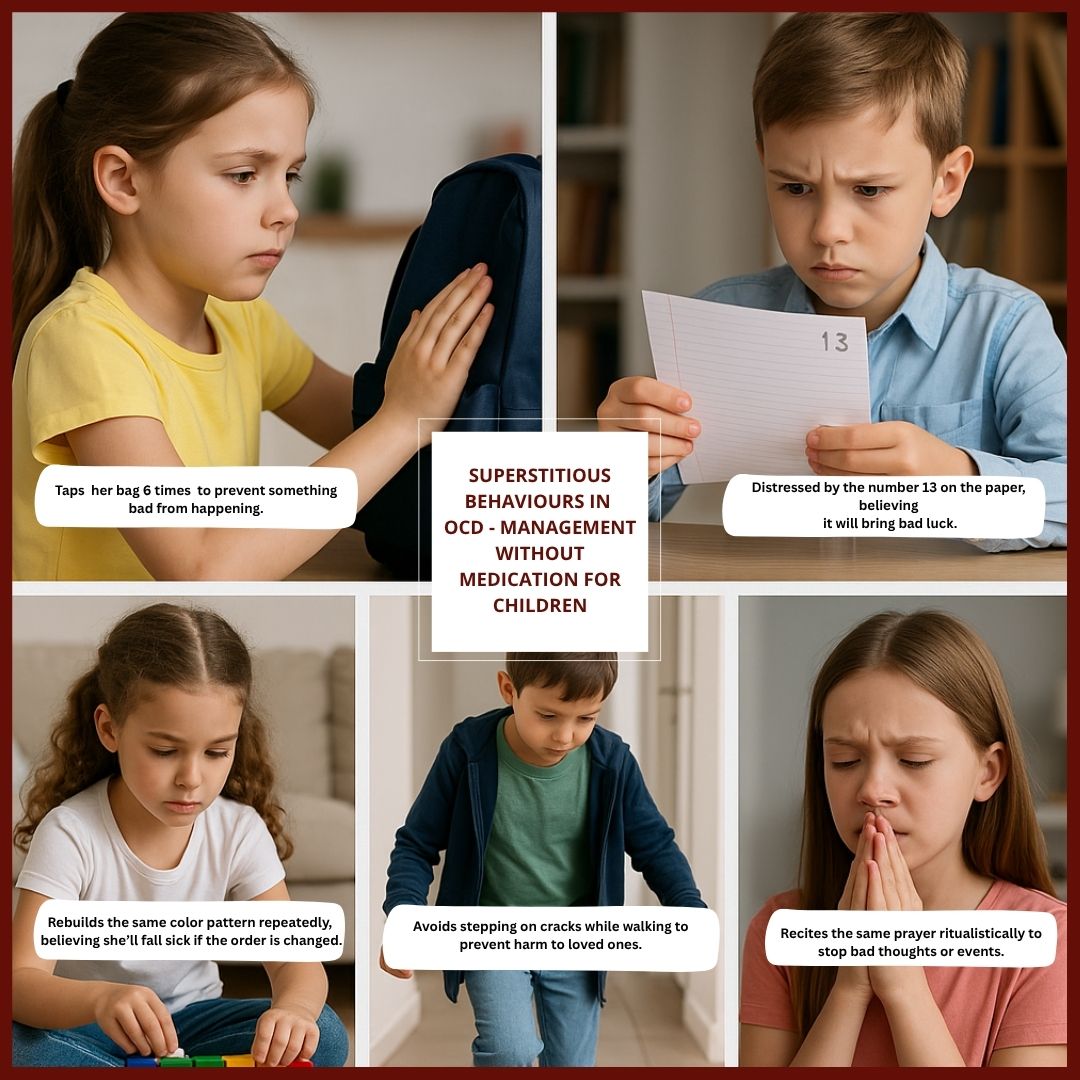
For example, a child may repeatedly touch an object, avoid a number, or repeat actions “just in case” they believe something bad might happen. A compulsion happens not because the behavior makes logical sense, but because the child feels intense anxiety if they do not complete it.
Superstitious behaviors in children with OCD: Early signs
Early signs of superstitious behaviors in children with OCD are often overlooked or mistaken for normal childhood habits. Parents may assume the child is simply going through a phase, especially when behaviors initially seem harmless.
For instance, a child may refuse to use certain numbers, repeat actions several times, or follow strict routines to feel “safe.” However, these behaviors can gradually become rigid, intrusive, and difficult to stop.
As OCD progresses, the child may feel increasing distress if rituals are interrupted or not completed correctly. Over time, these compulsions can begin interfering with daily life.
When therapy may be needed
Superstitious behaviours in children may indicate the need for professional support when they begin affecting a child’s everyday functioning. This may include problems with school, playtime, friendships, or family interactions.
Children may start avoiding activities that trigger anxiety or become overly dependent on rituals for comfort. Some may feel intense distress when they cannot perform behaviors “correctly.”
If left untreated, these compulsions can negatively affect a child’s self-esteem, emotional well-being, and overall development. Anxiety may increase, leading to emotional exhaustion and difficulties in coping.
Nature of superstitious behaviours in children
The nature of superstitious behaviours in children with OCD is often linked to magical thinking and irrational beliefs. A child may believe that thoughts or actions can prevent harmful events from happening.
For example, they may fear that having a “bad thought” could cause something terrible to happen. This pattern is often called thought–action fusion, where thoughts feel as dangerous as real actions.
Children may also believe that rituals, such as tapping, counting, or repeating phrases, can stop harm from occurring. Even when they understand these fears may not be logical, the anxiety still feels very real.
Unlike playful childhood imagination, these behaviors are driven by fear, emotional distress, and a strong need for control. Because children are still developing reasoning skills, these compulsions can quickly become overwhelming if not addressed early.
SYMPTOMS PRESENTED AS COMPULSIONS
Superstitious behaviours in children with OCD, children typically present as compulsive repetition of action or mental rituals that are engaged in the effort to prevent feared harm. These behaviors are motivated by fear and magical thinking, even though they might seem playful or harmless on the surface. Typical symptoms and signs are:
- Numerical compulsions are the avoidance of “bad” numbers (e.g., 13 or 666) or the repetition of actions in some “safe” numbers (e.g., turning a page four times or tapping the pen three times).
- Touching and balance rituals: Superstitious behaviours in children start touching things in certain ways or repeatedly shifting one’s body in an attempt to “balance” it, such as touching something on one side and stroking both arms.
- Word, color, or symbol avoidance: Superstitious behaviours in children start Avoidance of “bad luck” words such as “hurt” or “death,” or use of colors such as red out of fear of worst-case scenarios.
- Mental/verbal rituals: Saying words or prayers to oneself to undo unwanted thoughts, such as counting to 10 following exposures to an unpleasant photo.
- Symmetry and order fixations are about insisting that clothes, toys, or books are laid down precisely and becoming distressed if changed.
- Repetitive rituals: Doing the same things over and over again (e.g., the shoelaces) or entering a room in a specific manner until they are “just right.”
Impact of Superstitious behaviours in children
Even if Superstitious behaviours in children begins small, it is more than a minor habit when it begins to occupy significant amounts of time, disrupt a child’s play, school, or social life, or cause distress when interrupted. It can now affect the child’s overall development, self-esteem, and normal functioning, and indicate the necessity for early psychological intervention.
Cause of Superstitious behaviours in children
OCD children can also display superstitious behavior due to a combination of psychological, environmental, and social influences:
Psychological Factors: Such children with characteristics of excessive worrying, low ambiguity tolerance, and rigid thinking are more susceptible to compulsive rituals and anxieties.
Environmental Factors: in development of Superstitious behaviours in children Traumatic life experiences, changes (e.g., school changes or domestic conflict), or disturbances within routine may trigger or worsen compulsive behavior.
Social Factors: in development of Superstitious behaviours in children gradually start with overprotective parents, seeing nervous role models, or lack of support can strengthen the idea in the child that routines are needed for security.
All of these play a part in how a child manages stress, which in turn makes them return to repetitive, magical or superstitious behaviors as a source of comfort.
DIFFERENCE
While children in general partake in harmless superstitions, such as wearing a “lucky” school uniform, or staying away from street holes, they are overall playful and culturally oriented.
Superstitious behaviours in Children with OCD include:
- Stiff or rigid
- Driven by intense concern or a fear of the outcome
- Not for entertainment or use as custom, but to prevent perceived harm
- create anxiety if not met.
- interrupt on a daily basis (socializing, sleeping, education)
Examples: –
1. A child who will not approach black cats because they are “bad luck” (shared/cultural superstition) compared to a child who will not leave her house unless she knocks on the door eight times to safeguard herself (OCD-related).
2. One such cultural belief that is generally transmitted as tradition is the caution provided to children in the majority of Indian homes not to cut their nails in the evening. Most children can easily oblige. A superstitious compulsion brought about by OCD, and not by cultural belief, occurs if a child begins to believe that “if I cut my nails after sundown, someone in my family will die” and experiences intense fear or takes some action to “undo” it.
TREATMENT
Superstitious behaviours in children with OCD is usually managed with:
They may also reframe their phobias and challenge illogical thinking by using cognitive behavior therapy, or CBT.
Exposure to the situation of fear over time and without the compulsive response is called Exposure and Response Prevention (ERP).
Children who receive Acceptance and Commitment Therapy (ACT) are able to resist frightening thoughts without transforming them into behaviors, thereby improving psychological flexibility.
Mindfulness-based cognitive therapy, or MBCT, promotes awareness and not responding to intrusive thoughts.
Thematic play counseling with children examines anxiety and builds coping abilities through play, story, and metaphor. For e.g., TAT (Thematic Apperception Test) administration.
Psychological testing or assessment assists in enabling proper evaluation and treatment planning.
Parent monitoring, emotion control, and systematic planning are all included in wellness management, which provides end-to-end support.
CONCLUSION
OCD children may have low-intensity or age-appropriate superstition behaviors at onset, but they need treatment when they become repetitive, anxiety-provoking, and disrupt daily life. A child’s emotional health can be greatly improved through early identification and proper treatment and prevent long-term complications.