

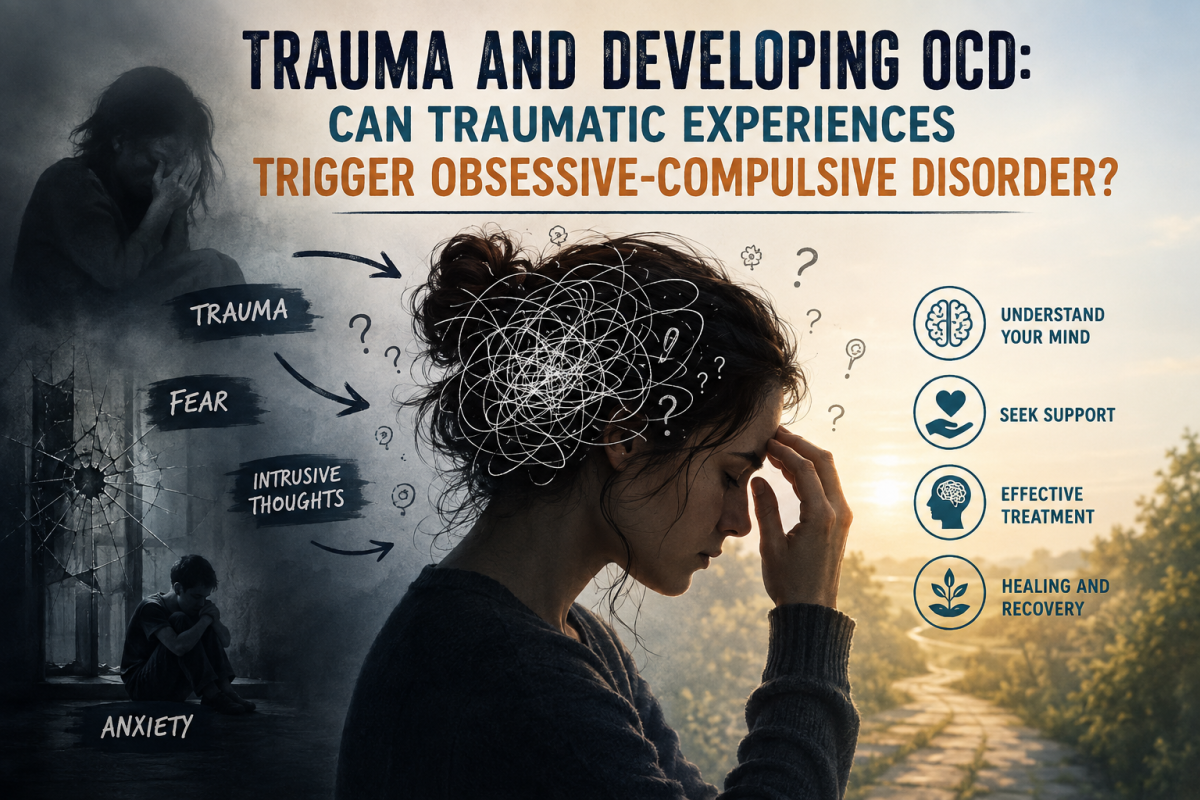
Trauma and Developing OCD: Can Traumatic Experiences Trigger Obsessive-Compulsive Disorder?
Trauma and Developing OCD: Traumatic experiences can significantly affect a person’s emotional wellbeing, sense of safety, and mental health. While trauma is often associated with anxiety, depression, and Post-Traumatic Stress Disorder (PTSD), some people also experience obsessive thoughts and compulsive behaviours following highly distressing events.
This raises an important question about the connection between trauma and developing OCD. Can a traumatic experience trigger Obsessive-Compulsive Disorder? Can childhood trauma contribute to obsessive thoughts? Why do some people begin experiencing compulsive behaviours after a stressful or traumatic event?
The relationship between trauma and OCD is complex. Not everyone who experiences trauma develops OCD, and not every person with OCD has experienced significant trauma. However, traumatic experiences may act as a trigger or contributing factor for OCD symptoms in some individuals, particularly those with existing biological or psychological vulnerabilities.
Understanding the relationship between trauma and developing OCD can help individuals recognise their symptoms and seek appropriate professional support.
What Is Trauma?
Trauma is a psychological and emotional response to an event or experience that feels overwhelming, frightening, threatening, or deeply distressing.
Traumatic experiences may include:
- Childhood abuse or neglect
- Physical or emotional abuse
- Sexual trauma
- Domestic violence
- Bullying
- Serious accidents
- Sudden loss of a loved one
- Medical trauma
- Relationship betrayal
- Exposure to violence
- Natural disasters
- Long-term emotional neglect
- Repeated stressful experiences during childhood
People respond differently to traumatic experiences. The impact of trauma can depend on several factors, including age, personality, previous experiences, emotional support, coping abilities, and individual vulnerability.
Can Trauma Cause OCD?
The question can trauma cause OCD does not have a simple answer.
OCD is a complex mental health condition influenced by multiple factors. These may include genetics, brain functioning, personality traits, anxiety sensitivity, environmental stress, and life experiences.
However, when discussing trauma and developing OCD, it is important to understand that trauma may sometimes act as a trigger rather than being the single cause of the condition.
Following a traumatic experience, a person may become increasingly focused on danger, uncertainty, responsibility, and preventing future harm.
They may begin asking themselves:
- What if something terrible happens again?
- What if I fail to protect someone?
- What if I accidentally cause harm?
- What if I lose control?
- What if I miss something important?
- What if I am responsible for another bad event?
For some individuals, these fears can develop into repetitive obsessive thoughts.
How Trauma May Contribute to Developing OCD
The connection between trauma and developing OCD may involve changes in how a person responds to fear, uncertainty, intrusive thoughts, and perceived threats.
After trauma, the brain may become highly alert to possible danger. A person may constantly monitor their surroundings, memories, emotions, and thoughts.
This increased state of alertness can contribute to:
- Hypervigilance
- Excessive worrying
- Fear of uncertainty
- Increased responsibility
- Repeated checking
- Reassurance seeking
- Avoidance
- Intrusive thoughts
A person may then attempt to reduce their anxiety by performing certain behaviours repeatedly.
Trauma, Intrusive Thoughts and OCD
One important connection between Trauma and Developing OCD involves intrusive thoughts.
Intrusive thoughts are unwanted thoughts, images, urges, or doubts that enter the mind unexpectedly. They can be disturbing, frightening, or completely inconsistent with a person’s values.
After trauma, the brain may become more sensitive to perceived threats. This can make unwanted thoughts feel more significant or dangerous.
For example, a person may experience thoughts such as:
- What if I hurt someone?
- What if something terrible happens?
- What if I lose control?
- What if I become responsible for another tragedy?
- What if I cannot trust my memory?
- What if I made a mistake without realising it?
The presence of an intrusive thought does not mean that the thought is true or likely to happen.
However, people experiencing OCD may interpret intrusive thoughts as meaningful, dangerous, or requiring immediate action.
This interpretation can increase anxiety and lead to compulsions.
The OCD Cycle After Trauma and Developing OCD
When exploring trauma and developing OCD, it is helpful to understand how the obsessive-compulsive cycle works.
A typical cycle because of Trauma and Developing OCD may look like this:
Trigger → Intrusive Thought → Anxiety → Compulsion → Temporary Relief → Obsession Returns
For example:
A person experiences a traumatic event involving illness.
↓
They later develop an intrusive fear about contamination.
↓
The thought creates intense anxiety.
↓
They repeatedly wash their hands.
↓
Their anxiety temporarily decreases.
↓
The brain learns that handwashing provides temporary relief.
↓
The fear returns again.
Over time, compulsive behaviours may become more frequent and difficult to resist.
This cycle can significantly affect daily life, relationships, work, and emotional wellbeing.
Childhood Trauma and Developing OCD
The relationship between childhood Trauma and Developing OCD is particularly complex.
Childhood is an important period for emotional development. Experiences involving abuse, neglect, criticism, unpredictability, bullying, or family conflict can influence how a child learns to respond to fear and uncertainty.
Some individuals with difficult childhood experiences may develop patterns such as:
- Excessive responsibility
- Perfectionism
- Fear of making mistakes
- Fear of disappointing others
- Excessive guilt
- Difficulty tolerating uncertainty
- Constant self-monitoring
- Hypervigilance
These patterns do not automatically lead to OCD.
However, in some vulnerable individuals, childhood experiences may contribute to the psychological environment in which obsessive-compulsive symptoms later develop.
Emotional Trauma and Trauma and Developing OCD Symptoms
Emotional trauma can sometimes increase feelings of insecurity, vulnerability, and loss of control, and eventually lead to Trauma and Developing OCD.
After emotionally distressing experiences, some individuals may attempt to regain control by becoming extremely careful about their thoughts and behaviours.
They may begin repeatedly asking:
- Did I do something wrong?
- Did I hurt someone?
- Did I make the correct decision?
- What if I missed something?
- What if I am responsible?
- Can I be completely certain?
The desire for complete certainty can become particularly challenging for people with OCD.
Since complete certainty is impossible in many areas of life, the person may repeatedly check, analyse, avoid situations, or seek reassurance.
These behaviours can become compulsions.
Trauma-Related OCD Symptoms
OCD symptoms can appear in many different forms. The content of obsessive fears may sometimes be influenced by a person’s past experiences.
Harm OCD
A person may develop intense fears about accidentally harming themselves or others.
They may repeatedly check:
- Knives or sharp objects
- Electrical appliances
- Vehicles
- Doors and locks
- Their memories
- Their actions
They may also mentally review situations repeatedly to make sure they did not harm anyone.
Contamination OCD
After experiences involving illness, injury, medical treatment, or contamination fears, some people may become excessively concerned about germs, diseases, or contamination.
This may result in:
- Excessive handwashing
- Repeated cleaning
- Avoiding public places
- Avoiding physical contact
- Repeatedly disinfecting objects
Responsibility OCD
Traumatic experiences may sometimes increase a person’s sense of responsibility for preventing harm.
The person may believe that they must constantly monitor situations to prevent something terrible from happening.
This can lead to excessive checking and reassurance seeking.
Religious or Moral OCD
Some individuals may experience excessive guilt, fear of wrongdoing, or fear of being morally responsible for something bad.
They may repeatedly pray, confess, mentally analyse their behaviour, or seek reassurance about whether they are a good person.
Relationship OCD
Past betrayal, abandonment, or emotionally painful relationships may sometimes influence obsessive doubts about relationships, trust, attraction, or commitment.
PTSD and OCD: What Is the Difference?
Trauma-related symptoms and OCD symptoms can sometimes appear similar. However, PTSD and OCD are different mental health conditions.
PTSD Symptoms May Include:
- Flashbacks
- Nightmares
- Avoidance of trauma reminders
- Hypervigilance
- Emotional distress
- Fear responses
- Distressing memories
OCD Symptoms May Include:
- Recurrent intrusive thoughts
- Persistent doubts
- Compulsive behaviours
- Mental rituals
- Reassurance seeking
- Repeated checking
- Excessive washing
- Avoidance
A person can experience both PTSD and OCD.
In some cases, trauma-related anxiety and obsessive-compulsive symptoms may interact with each other. This is why a careful professional assessment is important.
Can Trauma Make Existing OCD Worse?
Yes, stressful or traumatic experiences can sometimes worsen existing OCD symptoms.
Periods of stress may increase:
- Frequency of intrusive thoughts
- Anxiety levels
- Compulsive behaviours
- Avoidance
- Reassurance seeking
- Mental checking
Someone who previously managed mild OCD symptoms may experience a significant increase in symptoms following a traumatic event or major life stress.
This does not mean that recovery is impossible.
It means that treatment may need to address both the current OCD cycle and any relevant trauma-related symptoms.
Treatment for Trauma Trauma and Developing OCD
When someone experiences both trauma-related symptoms and OCD, treatment should be carefully individualised.
Exposure and Response Prevention (ERP)
Exposure and Response Prevention, commonly known as ERP, is a specialised psychological treatment approach for OCD.
ERP helps individuals gradually face obsessive triggers while reducing compulsive responses.
For example, instead of repeatedly checking something to obtain certainty, the individual may gradually learn to tolerate the uncertainty without performing the compulsion.
The goal is not to eliminate every intrusive thought.
The goal is to change the person’s response to intrusive thoughts and anxiety.
Cognitive Behavioural Therapy for OCD
Cognitive Behavioural Therapy may help individuals understand the relationship between thoughts, emotions, and behaviours.
For OCD, treatment should specifically focus on obsessive-compulsive patterns rather than only providing general anxiety management techniques.
Trauma-Informed OCD Treatment
When discussing trauma and developing OCD, it is important that treatment recognises both conditions when they coexist.
A trauma-informed approach may consider the individual’s emotional history while also identifying:
- Trauma-related avoidance
- OCD avoidance
- Compulsions
- PTSD symptoms
- Intrusive memories
- OCD intrusive thoughts
Understanding these differences can help professionals create a more appropriate treatment plan.
Can Someone Recover From Trauma-Related OCD?
Many individuals experience significant improvement when they receive appropriate professional support and evidence-based treatment.
Recovery can involve:
- Reducing compulsive behaviours
- Responding differently to intrusive thoughts
- Increasing tolerance for uncertainty
- Reducing avoidance
- Managing anxiety
- Returning to meaningful activities
- Improving relationships
- Building confidence
Recovery does not necessarily mean never experiencing anxiety or intrusive thoughts again.
Instead, it means learning that intrusive thoughts and uncomfortable emotions do not have to control behaviour.
Final Thoughts on Trauma and Developing OCD
The relationship between trauma and developing OCD is complex and different for every individual.
Trauma does not automatically cause OCD, and OCD cannot always be explained by one particular life event. However, traumatic experiences may trigger, worsen, or influence obsessive-compulsive symptoms in some people.
For individuals struggling with obsessive thoughts after a traumatic experience, understanding the difference between intrusive thoughts, trauma responses, anxiety, and compulsive behaviours can be an important first step.
The most important message is that OCD is treatable. With appropriate assessment and specialised support, individuals can learn to reduce compulsions, develop healthier responses to anxiety, and regain control over their daily lives.
If you are experiencing symptoms related to trauma and obsessive-compulsive disorder, consulting a qualified mental health professional or OCD specialist can help you understand your symptoms and explore appropriate treatment options.
Frequently Asked Questions About Trauma and Developing OCD
Can trauma lead to developing OCD?
Trauma may act as a trigger or contributing factor for OCD symptoms in some vulnerable individuals. However, not everyone who experiences trauma develops OCD, and OCD usually involves multiple biological, psychological, and environmental factors.
Can childhood trauma cause OCD?
Childhood trauma may influence anxiety, hypervigilance, guilt, fear, and emotional development. These factors may contribute to vulnerability in some individuals, but childhood trauma alone does not automatically cause OCD.
Can OCD start after a traumatic event?
Some people experience the onset or worsening of OCD symptoms following a traumatic or highly stressful event. Trauma may increase anxiety, intrusive thoughts, hypervigilance, and the need for control.
What is trauma-related OCD?
Trauma-related OCD is a term sometimes used when obsessive-compulsive symptoms begin or become more severe following traumatic experiences. A professional assessment is important because trauma symptoms and OCD symptoms can sometimes overlap.
Can someone have both PTSD and OCD?
Yes. PTSD and OCD are separate conditions, but some individuals may experience symptoms of both. Treatment should consider the individual’s specific symptoms and psychological needs.
What is the best treatment for Trauma and Developing OCD?
Treatment depends on the individual’s symptoms. OCD-focused approaches such as Exposure and Response Prevention (ERP), combined with appropriate trauma-informed psychological care when necessary, may be considered by qualified mental health professionals.
Contact us:
Call: +91 9368503416
Email: info@emotionoflife.in
Visit: Emotion of Life Official Website
Book Now | Review | OCD Types | Meet Our Experts | Success Stories| Contact Us| MyPsychologist