


Can someone have OCD without showing any sign of compulsion on the outside?
Yes. It’s possible, and experts call that subtype Pure O OCD.
An individual with a typical form of OCD shows compulsive behaviors like handwashing, checking, or arranging objects. But Pure O OCD is different. It’s concealed underneath, and the compulsions, although they seem non-existent, run a storm of rumination, mental checking, and reassurance‑seeking on the inside.
This OCD type is often misunderstood and shrouded by myths and stigma, making it one of the most difficult to diagnose and treat. Let us guide you to understand it better.
What is Pure O OCD?
Pure O is a subtype of OCD where the intrusive thoughts lead to no physical or visual compulsions (like washing hands or checking for reassurance). Instead, the compulsions go on inside the mind.
Instead of any outward compulsion, the distressing, intrusive thoughts make individuals ruminate, seek reassurance, and neutralize their thoughts rather than act on them.
While the name “Pure O OCD” might only stress the obsession part, the only thing differentiating this OCD subtype of OCD is the observability of the compulsions. Unlike other subtypes, individuals with Pure O don’t have observable signs of compulsion.
Individuals with a pure O typically have intrusive thoughts that are otherwise very embarrassing, shameful (often taboo in nature), and illegal. Sufferers typically conceal their thoughts and compulsions related to it. As a result, intrusive thoughts OCD treatment become difficult due to the failure of diagnosis.
Pure O OCD isn’t Real?
This subtype of OCD is a real form of obsessive-compulsive disorder. It’s recognized by professionals as one of the most distressing forms of OCD. However, the name “Pure O” is often misleading since the focus is often only left to ‘obsession’ due to the lack of visually manifested compulsion.
Also, it’s not a formal diagnosis in the DSM-5 (Diagnostic and Statistical Manual of Mental Disorders, 5th Edition), although the term is widely used to describe the manifestation of this type of OCD.
Symptoms of Pure O OCD
Your friend, or someone in the family, might seem completely fine on the outside and still be dealing with Pure O OCD. Yes, the compulsions are hardly visible, and the obsession festers inside. But, despite the invisibility of the compulsions, they exist, making it (as said before) difficult to diagnose this OCD subtype.
The following are the common symptoms of the Pure O subtype of OCD:
Pure O OCD Intrusive Thoughts
You’re in the driver’s seat, driving, and suddenly, a thought of crashing into a roadside barn crosses your mind. Or it could be worrying, “does he/she love me?” while hunching over your work desk.
Repetitive intrusive thoughts are among the key symptoms of Pure O OCD, and the obsession with these thoughts can manifest in one or many of the following forms:
Harm/Violence: Sufferers often have intrusive thoughts of being capable of violence and harming others or themselves.
Sexual Orientation/Taboo: They often have recurrent thoughts doubting their sexual orientation or experience distressing, non-consensual sexual images.
Relationship (ROCD): They can constantly have irrational doubts about whether their partner is truly the one they should have fallen in love with. It leads to the need for absolute certainty that almost never comes.
Religiosity/Scrupulosity: Sometimes, sufferers have intrusive thoughts regarding doing something blasphemous, sacrilegious, or sinful. These thoughts are often against their religious core beliefs, leading to doubts.
Responsibility/Accidental Harm: Obsessive intrusive thoughts also center around being responsible for catastrophic events. For example, the fear of leaving the gas stove or oven on and harming others by accident.
These thoughts can be recurrent and preoccupy an individual with the contents surrounding the thoughts. Eventually, it can lead to emotional distress, a mental cycle that is difficult to break.
Pure O OCD Compulsion
No. There’s usually no visual or physical sign of compulsion while an individual is going through Pure O OCD. They aren’t rushing to recheck if they have locked the door, or washing their hands to ensure that dirt’s washed away.
But, these individuals still engage in mental rituals and ruminations to alleviate the stress; meaning, the compulsions aren’t visible on the surface. But they exist, and this is what they often appear to be:
- Sufferers often chant, pray, or murmur to counteract the distressing thoughts.
- Sometimes, they mentally replay past events to search for mistakes and find alternate endings by changing their actions.
- They also try out thought-suppressing techniques and try to push away distressing thoughts.
Although these inward compulsions aren’t visible on the surface, they serve the same purpose of locking away, dealing with, or suppressing intrusive thoughts. The internal compulsions can contribute to embarrassment and shame, and also make the sufferers hide their struggles on the inside.
Compulsions of an OCD type (when visible) help identify and diagnose the symptoms. In the Pure O subtype, spotting the signs early on becomes difficult since the compulsions are internal. The internal compulsion aspect plays a crucial role in understanding how it parallels other forms of OCD.
How does Pure O OCD differ from Typical OCD?
Here’s a clear comparison table between Pure O OCD and Typical (Traditional) OCD, based strictly on the Talkspace article you shared.
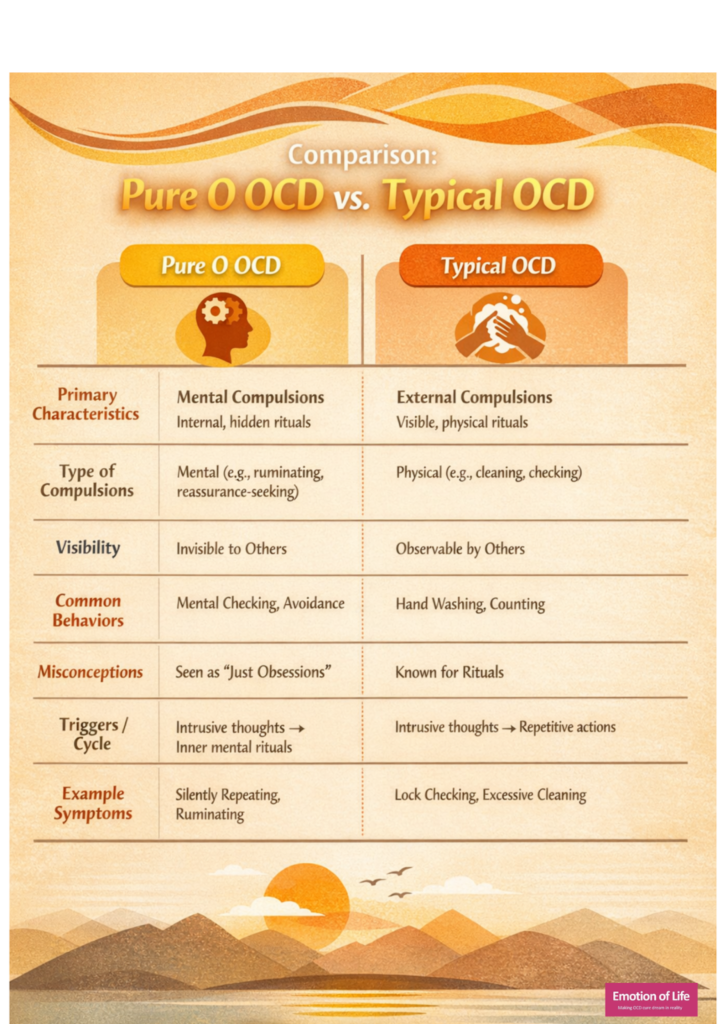
Treatment: Breaking the Mental Cycle
The treatment of Pure O OCD majorly involves specialized therapies and medication aimed at breaking the mental cycle. Specialists try to break the pattern of intrusive thoughts. The combination of treatment for this type of OCD usually includes CBT (cognitive behavioral therapy), ERP (Exposure & Response Prevention), and ACT (Acceptance & Commitment Therapy).
CBT for Pure O OCD
Unlike typical OCD, where therapists break the cycle of physical compulsion, Pure O requires breaking the cycle of inward rumination. For example, someone with Pure O says something in a context/environment. Next, they compulsively analyze for certainty, often thinking, ‘did I mean that?’
So, how does it work for Pure O?
CBT for pure O OCD follows the process of recording one’s thoughts, then using them for cognitive restructuring by challenging irrational beliefs associated with obsession. Following both, experts run behavioral experiments to test out the validity of the fear.
Here’s a table explaining how CBT works for the Pure O subtype of OCD.
| Component | Description | Pure O Example |
| Thought Record | Log obsessions, plus emotions | Obsession: “What if I’m a danger?” Note trigger (saw knife), rate distress (8/10). |
| Cognitive Restructuring | Dispute irrational beliefs | Challenge: “One thought ≠ action. I’ve never harmed anyone.” Replace with: “OCD doubt, not reality.” |
| Behavioral Experiments | Test fears safely | Prediction: “If I don’t analyze for 15 min, disaster happens.” Test and see by not analyzing. The result: nothing bad occurs, and mental distress drops. |
ERP for Pure O OCD
Dealing with the inward and mental compulsion of Pure O is difficult. But the gold standard of OCD, ERP (Exposure & Response Prevention), teaches the brain that uncertainty is survivable.
Pure O can sometimes resist medication; hence, ERP is a much-needed solution to build resistance against it. In this process, the individuals are placed in triggering situations while deliberately blocking the rituals (such as rumination, reassurance-seeking) and so on.
| Step | Description | Pure O Example |
| Exposure | Deliberately trigger an obsession | Replay “What if I hurt my child?” thought/script for 10 min without escape. |
| Response Prevention | Block mental compulsions | No analyzing, reassuring self, or avoidance—sit with distress 100%. |
ACT for Pure O OCD
Finally, the third type of treatment for OCD is acceptance and commitment therapy. It’s really helpful for managing pure O. The treatment is all about letting intrusive thoughts pass and learning not to react to them negatively.
It works on acceptance and encouraging individuals to focus on their personal values and goals. Therapists help individuals not to fight with the intrusive thoughts, instead, encouraging them to align their core values with their personal beliefs. In short, this treatment focuses on presence, defusion, and value-driven steps. Here’s a table explaining how ACT works for the Pure O type of OCD.
| Element | Description | Pure O Example |
| Acceptance | Welcome thoughts without resistance | “Blasphemous thought here—OK, it’s just noise, not truth.” Let discomfort ride. |
| Mindfulness | Observe thoughts non-judgmentally | “Leaves on a stream”: Watch “I’m evil” float by without grabbing it. |
| Commitment to Action | Act per values despite discomfort | Value: Family → Cook dinner even with “harm OCD” spike. |
Pure O OCD Myths Debunked
OCD itself is often misunderstood, and its types are no exception. The following are some myths surrounding pure O and the reality that you must know about.
Myth 1: “Pure obsessions only—no compulsions.”
Reality: That’s not true. Every OCD type has its compulsions. For Pure O, the compulsions are hidden because they mostly happen internally in the form of reviewing, reassurance seeking, and neutralizing prayers. They mimic “overthinking,” fueling the cycle.
Myth 2: “Not a DSM subtype.”
Reality: Yes. That’s correct, that Pure O is not a DSM-5 subtype. However, it’s a clinical descriptor for OCD with covert compulsions. It’s validated by IOCDF/experts, and it aids the diagnosis of “hidden” cases.
Myth 3: “Just Overwhelmedness/GAD, not OCD.”
Reality: OCD doubts clash with your values and fuel rituals; GAD worries feel real. Pure O responds to ERP the same way as regular OCD.
Myth 4: “Untreatable without meds.”
Reality: Here’s another Pure O claim that’s a myth. Most treatments of Pure O and other types of OCD typically go through treatments like ERP, ACT, and CBT. A combination of therapy and required medications helps treat Pure O-type OCD.
Takeaway: Pure O is a legitimate variation, not fiction. Recognize internal compulsions; seek ERP for recovery.
When to Seek Help?
Obsessions can hijack your daily life, and Pure O OCD traps you into a mental loop that’s hard to get out of. You keep getting intrusive thoughts about harming, contaminating, or taboo, putting you through constant discomfort. It can disrupt your work, affect your sleep cycle, and strain your relationships.
If you’re feeling like going through a similar condition, feel free to ask for help. It’s best not to wait for compulsion to surface. Pure O requires care from experts specializing in helping you with it.
At Emotion of Life, our expert therapists deliver tailored ERP therapy and compassionate coaching to break free from mental torment. Reclaim clarity and peace, and contact us today for personalized Pure O recovery.
OCD doesn’t Always Show on the Outside
While compulsive behaviors are typically the first sign of OCD, subtypes like Pure O OCD are difficult to diagnose. It stays hidden, and the mental review, rumination, and reassurance seeking are usually difficult to spot on the outside. But it’s there, and it’s very much real.
While myths and misconceptions might cloud the understanding of Pure O, the truth remains clear: it is a legitimate, clinically recognized pattern of OCD that responds well to structured therapy. Early recognition and informed treatment pave the way toward relief, recovery, and a life no longer ruled by silent mental battles.