
For many who live with Obsessive-Compulsive Disorder, the struggle begins long before it manifests.
You could have a person sitting silently at their work desk, trying to do their job while simultaneously fighting off intrusive thoughts. You could have a friend checking if the door’s locked for half a dozen times before leaving home, not because they are overcautious or even “fussy”, but simply because their mind won’t stop whispering to them.
If you have labelled someone as too clean or too dramatic about the little things that you say shouldn’t matter, think again.
These individuals, human beings with regular lives like yours, could be wrestling with an intense sense of fear or guilt or even a feeling that something terrible may come to pass if they don’t listen to the thoughts in their head about performing a ritual to the letter.
These experiences aren’t character traits or quirks even—they are internal battles, invisible for certain, misunderstood often.
If you are someone looking to learn about OCD and/or trying to make sense of your or your loved one’s unusual experiences, let this article act as a light to guide you through the tunnel towards a gentle, human-centred explanation beyond the stereotypes.
How Society Generally Looks at OCD
Society tends to relegate OCD to a corner of its conversations where it becomes more of a punchline or a joke. The examples are many:
“God, you clean so much, you have got OCD!”
“What’s funny is that he washes his hands with soap multiple times throughout the day.”
And so on.
Such phrases and the manner in which they are thrown around in our day-to-day lives seem harmless or, at worst, irritating. But they actually overshadow the deeper reality that OCD isn’t a practice of keeping things neat or symmetrical.
It’s a mental health condition, or in slightly more technical terms, a psychological disorder. It exhibits symptoms of intrusive thoughts that distress and the resultant compulsive ritual that the person feels compelled to repeat. Even when they don’t want to.
However, rampant stereotyping, uneducated comments or off-handed remarks make it hard for those with OCD to come forward and seek medical help. Instead, they prefer to hide their condition out of embarrassment.
The first step to solving this is to understand what OCD is all about.
What Is Obsessive-Compulsive Disorder?
Defining Obsessive-Compulsive Disorder (OCD) involves laying bare that it has two aspects to it: obsessions and compulsions.
Obsessions are characterised by intrusive thoughts or fears that create discomfort, while compulsions are repetitive physical or mental acts performed to temporarily satisfy obsessions. What’s truly troubling is that the person who has OCD knows their thoughts are irrational, but finds it nearly impossible to ignore them.
Some compulsions stemming from obsessions include:
- Washing hands repeatedly
- Repeating certain actions until they “feel right”
- Asking for reassurance from others
Remember, compulsions never bring pleasure, although it may appear so. They are a temporary respite in a world of intrusive thoughts consistently poking at you. And the thoughts often return stronger. So, in a way, OCD can also be termed as obsessive thinking disorder.
Different Types of OCD
OCD, although principally a combination of obsessions and compulsions, can be segregated into multiple OCD types.
- Contamination OCD
This is characterised by a fear of germs or getting dirty. It involves excessive washing or the avoidance of “contaminated” things.
- Checking OCD
The repetitive checking of locks, appliances, emails, and anything to try to avoid mistakes or harm.
- “Just Right” OCD
The individual is driven to arrange and align things until they achieve “balance”.
- Harm OCD
Intrusive thoughts that lead to people visualising hurting themselves or others. This results in avoidance and looking for reassurance.
- Relationship OCD (ROCD)
This is when a person has uncontrolled doubts about love and compatibility. It creates cycles of needing reassurance and overanalysing relationships.
- Religious and Moral OCD
This is the fear of being immoral or offending the gods. Excessive praying, confessing, or ritualising are hallmarks of this OCD type.
- Sexual Orientation / Identity OCD
This is OCD that causes intrusive doubts about sexual or gender identity. Symptoms are compulsive checking, overanalysis, and looking for reassurance.
- Somatic / Sensorimotor OCD
In some cases, people are hyper-aware of their breathing, blinking, or other bodily sensations. Naturally, when they make efforts to control such critical functions that are a part of their daily lives, the situation becomes overwhelming.
- Existential OCD
As the name suggests, this type of OCD manifests in the form of symptoms where the individual is triggered by questions about existence, leading to constant contemplation.re the individual is triggered by questions about existence, leading to constant contemplation.
How OCD Affects Emotional Well-Being and Relationships
At this point, it is clear that OCD makes people behave unusually because they cannot ignore obsessions, nor control their compulsions. It is exhausting, both on the person in question and their relationships. The struggle manifests in the form of:
- Constant fear
- Guilt over intrusive thoughts that can be quite overwhelming
- Shame for having minimal to no control over one’s mind
- The fatigue that builds up over repeated rituals
- A lack of focus in the moment
- Avoiding people or places that act as triggers
When it comes to relationships, overthinking, a constant need for reassurance, the fear of doing things wrong, and even an emotional withdrawal in the wake of a constant bombardment of intrusive thoughts in the head, all contribute to strains.
What’s more, there are cases where people didn’t open up to their close ones out of fear of burdening them.
How people feel, how they connect, and even their opinion of themselves are affected by Obsessive-Compulsive Disorder.
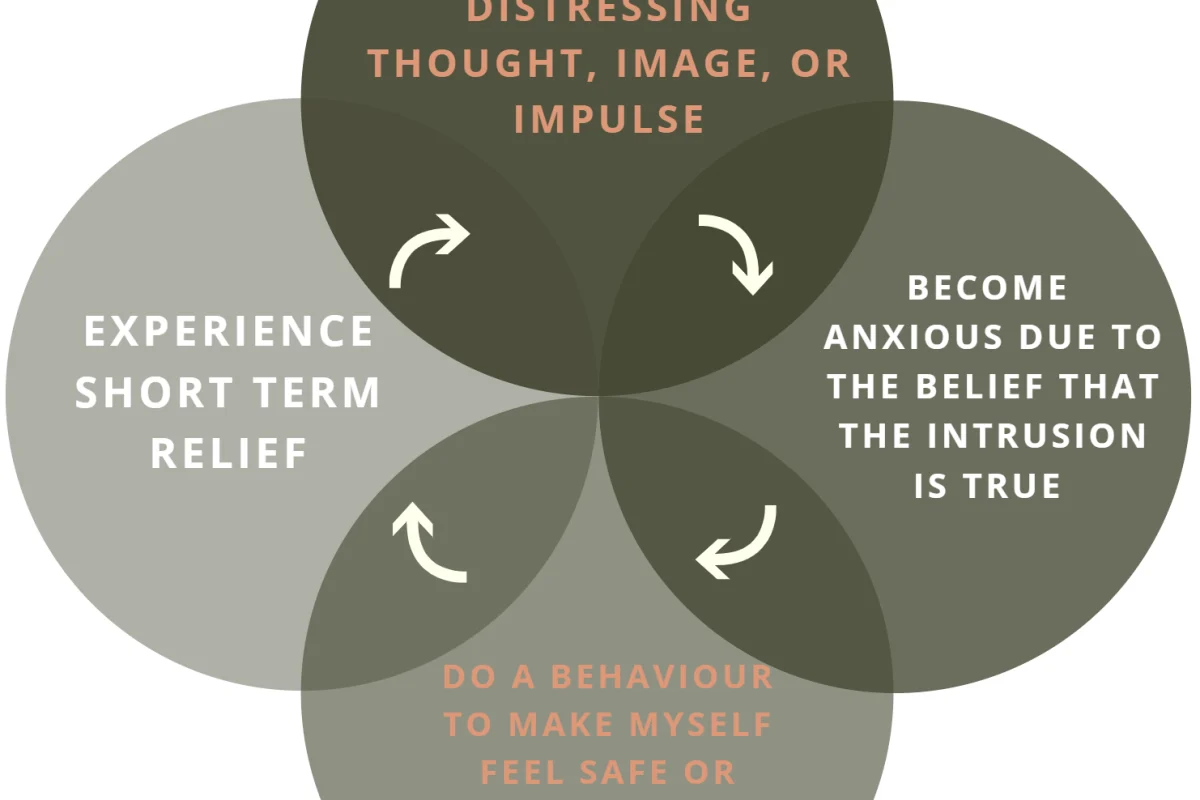
The OCD Cycle: How Thoughts Become Rituals
| The Trigger | The Intrusive Thoughts | The Distress Phase | The Compulsion | The (Temporary) Relief | The Stronger Cycle Emerges |
| Something activates or “triggers” a worry. Even something as commonplace as reading a news headline or a sound or even touching a door handle can elicit this. | The mind acts on this and generates an undesirable thought or image that gives shape and form to the worry. This transitions into the next stage: distress. | The intrusive thought now causes immense fear and panic or guilt that something is very wrong. This makes the person extremely desperate for a remedy, which shows as a compulsion. | The obsession at this stage has reached new heights where a ritualistic release is deemed “necessary” by the OCD-affected individual. It can be washing, praying, checking or craving reassurance, often uncontrollably. And at first, it feels freeing. | The weight on the shoulders is lifted and the panic vanishes. The person feels safe. All seems right in the world, and yet, it’s only for a short while. | As the ritual brought down the obsession the first time, at least temporarily, the brain understands that repeating the ritual would be therapeutic. The intrusive thoughts return with another trigger, but stronger. And the person repeats the ritual numerous times a day. |
What Causes OCD?
Grasping OCD conceptually is the first step on the road to recovery, both for the affected and their relationships. Individuals often think that something is wrong with them.
But, honestly, it develops from a combination of biology, experiences, and emotions. These aren’t anyone’s fault. Let’s break this down humanely, instead of just stating cold, hard facts.
1. Genetics
Yes, Obsessive-Compulsive Disorder can be in the family, and it can affect someone genetically. This is not a guarantee but simply indicates that there are some among us who may be more sensitive to intrusive thoughts.
Much like inheriting curly hair or perhaps a hair colour, it’s not a flaw.
2. Brain Structure & Neurotransmitters
Certain parts of the brain related to decision-making or threat detection may work differently in people who have OCD.
The culprit? The mood-regulating chemical, Serotonin, is also a neurotransmitter.
Serotonin imbalance leads to the brain being unable to stop intrusive thoughts. Again, this doesn’t mean someone is abnormal. Their brain just communicates or handles emotions differently.
3. Experiences and Emotional Triggers
OCD often develops during emotionally-charged situations. These may be:
- A major change in life
- Traumatic illness or injury
- Relationship stress
- Academic pressure (schools, colleges or at home)
- A loss (loved ones, a friend, a pet)
Symptoms often surface in childhood, a comparably more emotionally vulnerable period in our lives, and often go unnoticed. For some, symptoms begin in childhood — often disregarded.
It must be noted that stress doesn’t cause OCD. It can, however, catalyse symptoms in individuals predisposed to the condition. It can, however, activate symptoms in someone already predisposed.
| Whatever The Cause, It’s Nobody’s Fault No one chooses Obsessive-Compulsive Disorder or causes it. As a complex psychological condition dependent on multiple factors like biology, environment, stress, and the psyche, any guilt is both unfair and inaccurate. At the end of the day, it’s not about blaming but healing. |
A Supportive Society Breaks The Stigma
OCD is hard to cope with when those around us make fun of it or ignore it. Undermining the seriousness of it is equivalent to minimising the emotional weight that those with OCD have.
Changing our language or how we act regarding the topic is a promising direction. Instead of being dismissive, we should try to be empathetic, letting our curiosity teach us about it. This would create a safe environment where OCD-affected individuals would feel acknowledged instead of judged.
The other element to removing the stigma is to democratise the conversation. Being open and honest are key pillars, allowing people to speak their mind regarding experiences and challenges, and perhaps, even triumphs.
So, more than diagnosing someone, the focus should be on promoting a culture of understanding and supporting mental health.
The Emotion of Life Promise
Emotion of Life offers an extremely structured OCD Recovery and Cure Program. It is outcome-driven and designed for timely recovery with a science-backed 365-day Cure State Certification Model.
This means that unlike conventional approaches for symptom control, we address the underlying cause of OCD. Our approach comprises a highly systematic and multi-layered recovery framework that enables complete personal transformation.
Get in touch with us and get on the road to recovery.