Understanding the Obsessive-Compulsive Cycle Behind Pornography Dependence
Porn Addiction as OCD In today’s hyper-digital world, pornography has become instantly accessible, private, and neurologically stimulating. What begins as curiosity or stress relief can gradually transform into repetitive dependence. Many individuals attempting to quit pornography report a painful paradox:
Porn Addiction as OCD in this issue person usually have “I don’t want to watch — but I feel compelled to.” This inner conflict reflects that, for a significant group, porn addiction is not merely behavioural indulgence — Porn Addiction as OCD operates through an Obsessive-Compulsive Disorder (OCD) cycle. Understanding porn addiction through the OCD framework removes moral stigma and introduces structured, evidence-based recovery pathways.
Understanding Porn Addiction as OCD
Porn consumption may exist on three psychological levels:
| Behaviour Pattern | Core Driver | Emotional Outcome |
|---|---|---|
| Habit | Pleasure / curiosity | Neutral |
| Addiction | Dopamine craving | Escalation |
| OCD Compulsion | Anxiety relief | Guilt + distress |
In OCD-driven porn addiction:
- Urges are intrusive, not voluntary.
- Consumption is anxiety-reducing, not pleasure-seeking.
- Relief is temporary.
- Shame reinforces repetition.
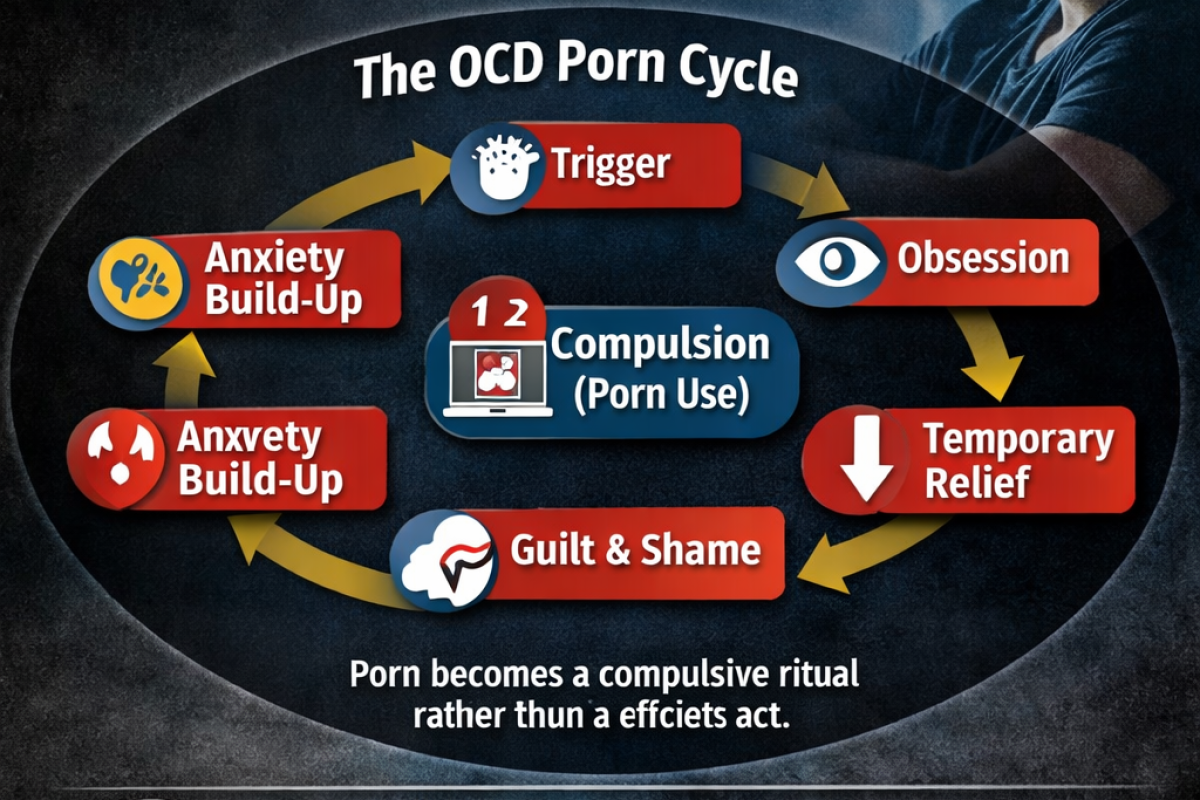
Porn becomes a compulsive ritual rather than a chosen act.
The OCD Cycle Behind Porn Addiction as OCD
The obsessive-compulsive loop operates as follows in Porn Addiction as OCD:
- Trigger
Stress, loneliness, boredom, intrusive sexual thoughts. - Obsession
Urges, images, or doubts create discomfort. - Anxiety Build-Up
Mental agitation and physiological tension rise. - Compulsion
Porn viewing or masturbation. - Temporary Relief
Anxiety drops briefly. - Guilt & Shame
Moral conflict, self-criticism. - Cycle Reinforcement
Brain learns porn = relief.
Over time, this becomes neurologically conditioned.
Types of OCD Linked With Porn Addiction
Porn compulsion frequently coexists with specific OCD subtypes:
Sexual Intrusive Thought OCD: Porn Addiction as OCD includes unwanted sexual imagery neutralized via porn checking.
Moral / Religious OCD: Watching followed by confession, repentance, or self-punishment in Porn Addiction as OCD is common.
Relationship OCD: Porn used to test attraction certainty.
Orientation OCD: Consumption to “verify” sexual orientation fears.
Guilt & Sin OCD: Compulsion followed by moral self-condemnation.
Thus pornography serves as both anxiety regulator and guilt trigger.
Psychological Impact of Porn Addiction as OCD
Excess stimulation weakens natural reward sensitivity.
Desensitization: Normal intimacy feels under-stimulating.
Escalation: Content novelty increases over time.
Emotional Numbness: Reduced empathy, bonding difficulty.
Cognitive Impairment: Decision fatigue and impulse dyscontrol emerge.
When OCD coexists, anxiety relief conditioning further strengthens neural loops.
Impact on Human Life
Porn addiction functioning as OCD disrupts:
Relationships: Trust deficits, intimacy withdrawal.
Marriage: Performance anxiety and emotional disconnect.
Productivity: Time loss, fatigue, distraction.
Social Life: Isolation increases compulsion reliance.
Spiritual Stability: Intense moral conflict develops.
Self-Identity: Persistent shame erodes confidence.
Shame, Guilt & Hidden Suffering
Most sufferers remain silent due to:
- Fear of judgment
- Cultural stigma
- Relationship consequences
- Moral labelling
Porn Addiction as OCD secrecy delays treatment and deepens compulsions. Recovery begins when shame is replaced by psychological understanding.
Clinical Consultation & Assessment Framework
Recovery begins with structured intake and psychological mapping to address Porn Addiction as OCD. A professional consultation typically evaluates:
- Time spent in porn urges and rituals
- Major obsessional thoughts
- Compulsive sexual behaviours
- Functional life impact
- Past treatment attempts
- Willingness for recovery
- Motivation drivers
This intake establishes therapeutic direction and readiness.
Severity Mapping of Porn Addiction as OCD
Porn compulsion severity can be clinically mapped using OCD engagement metrics. Severity is assessed through:
- Daily time spent in urges/rituals
- Resistance ability
- Functional impairment
Example Severity Spectrum for Porn Addiction as OCD
- Mild: 30–60 mins/day
- Moderate: 2–3 hrs/day
- Severe: 6+ hrs/day
- Chronic: 10+ hrs/day
Functional impairment increases proportionally in Porn Addiction as OCD, affecting work, relationships, and independence. Expanded severity staging also examines life functioning decline from mild interference to profound disability.
Is Recovery Possible
Yes porn addiction rooted in OCD is treatable. The brain’s compulsive conditioning can be reversed through structured therapy, behavioural retraining, and emotional processing. Recovery focuses on:
- Urge tolerance
- Anxiety processing
- Response prevention
- Identity restoration
Treatment Without Medication for Porn Addiction as OCD
When clinically appropriate, psychotherapy alone can produce sustainable recovery.
Cognitive Behaviour Therapy (CBT): Reframes distorted beliefs about urges and control.
Exposure & Response Prevention (ERP): Gradual exposure to urges without acting on them.
Acceptance & Commitment Therapy (ACT): Builds psychological flexibility.
Urge Surfing: Learning to observe urges without reacting.
Structured 16-Step Recovery Model Integration
A comprehensive OCD recovery framework includes multi-layered intervention stages:
- Initial Consultation: Assess willingness, subtype patterns, and severity.
- Psychological Assessment: Evaluates personality, emotional health, and OCD spectrum.
- Problem Statement Development: Defines therapy goals collaboratively.
- Structured Work Plan: Creates milestone-based recovery timelines.
- Therapy Foundation Course: Educates clients on OCD mechanisms.
- Daily Evidence-Based Therapy: CBT, ERP, ACT, and thematic interventions.
- Weekly Family Sessions: Trains families to reduce accommodation.
- Continuous Monitoring: Daily, weekly, and monthly progress tracking.
- Mid-Term Evaluation: Outcome recalibration after two months.
- Personality Development Work: Strengthens emotional resilience.
- Relapse Management Training: Prepares long-term coping systems.
- End-Term Evaluation: Measures milestone achievement.
- Three-Layer Recovery Validation: Ensures clinical recovery benchmarks.
- Post-Recovery Follow-Up: Six-month structured monitoring.
- Cured State Declaration: Issued after 360° validation
This model ensures recovery beyond symptom reduction — toward life transformation.
Unique Programmatic Strengths (USP Integration)
- Daily sessions instead of weekly therapy
- Focus on 360° life transformation, not just symptom control
- A 4-member therapeutic team:
- Lead Therapist
- Co-Therapist
- Progress Monitor
- Wellness Coach
- Multi-format delivery:
- Online (approx. 4 months)
- Onsite intensive (approx. 4 weeks)
- Hybrid customized model
- Quantitative progress tracking sheets
- Comprehensive psychological profiling
- Mandatory relapse prevention with follow-ups
Recovery Success Indicators
- Reduced urge frequency
- Increased delay tolerance
- Lower shame cycles
- Emotional stabilization
- Improved intimacy capacity
- Restored productivity
Recovery reflects both behavioural and identity shifts. Case Reflection Recovery Illustration.
Message of Hope
Porn addiction as OCD is not a moral defect,it is a treatable psychological cycle. With structured therapy, disciplined intervention, and guided monitoring:
- Urges weaken
- Anxiety stabilizes
- Shame dissolves
- Identity restores
Recovery is not suppression of sexuality — it is liberation from compulsive control. Human dignity returns when behaviour is no longer dictated by anxiety.
Contact
Email: info@emotionoflife.in
WhatsApp: 9368503416
Call for Discussion
Emotion of Life — OCD Treatment, Research & Training Institute.
Lead Specialists: Shyam Gupta & Pratibha Gupta.
We treat 70+ OCD subtypes and specialise in complex, chronic, and treatment-resistant cases. Non-medication recovery using CBT, ERP, and holistic wellness integration.
Book Now | Review | OCD Types | Our Experts | Success Stories| Contact Us|
MyPsychologist